A decade ago, a collision was documented with blurry photos, conflicting witness statements, and handwritten notes. The truth of the incident was almost always a matter of interpretation. That’s changed fast.
Today, the vehicle itself is frequently the most reliable witness, recording the crucial seconds before, during, and after an impact. This shift comes down to the rapid adoption of artificial intelligence and vehicle telemetry (cloud-stored data that details a car’s movement and system status in real time). The technology inside the car has far outpaced the insurance and legal paperwork that follow a crash. And this new digital evidence trail is transforming the collision repair workflow, creating greater efficiency for insurers while also raising complex questions about data ownership, estimate accuracy, and legal liability for car owners. If you drive anything built in the last five or six years, this stuff probably affects you more than you realize.
What Are AI Diagnostics and Vehicle Telemetry?
Getting your head around the modern collision repair process starts with two core technologies: vehicle telemetry and AI-powered diagnostics. These systems turn a physical event, such as a crash, into a digital file that can be analyzed, estimated, and settled, often before a tow truck has even left the scene. What used to be a hands-on, manual assessment has become a data-first, automated one. Not where you’d expect body shop culture to end up, right?
Demystifying Vehicle Telemetry
Think of vehicle telemetry as the car’s nervous system, constantly sending data to the cloud. The technology has evolved from basic GPS tracking in commercial fleets to a standard feature in many new passenger vehicles. According to industry analysis, AI telematics enables real-time analysis of driving behavior by processing inputs such as acceleration, braking, cornering, and speed to generate detailed driver and vehicle profiles.
These systems provide continuous insights to manufacturers and, increasingly, to insurers. They track key data points such as braking patterns, steering inputs, GPS location, and system warnings to reconstruct events with high precision. Picture a black box for your daily commuter; that’s essentially what’s riding along in your dashboard now.
The Role of AI in Damage Assessment
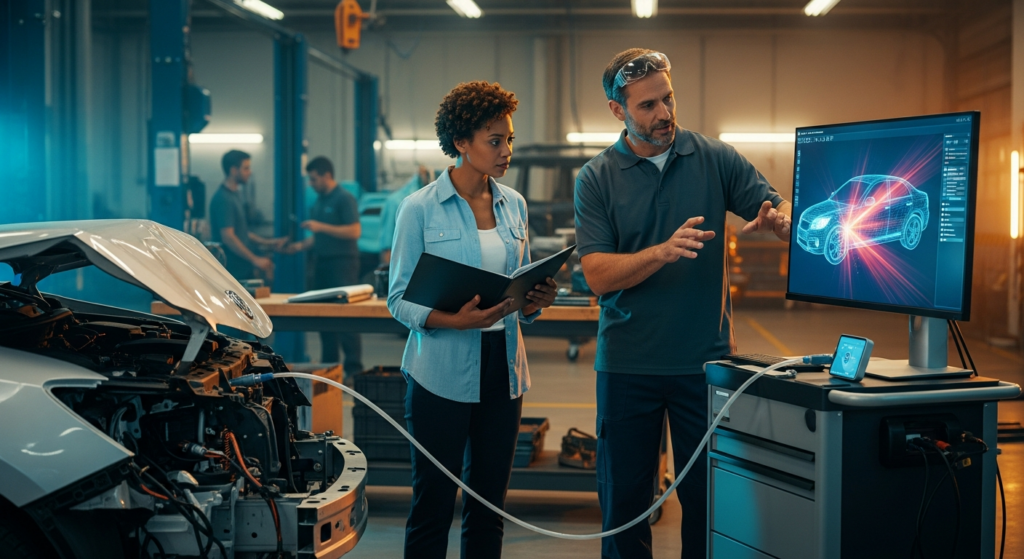
While telemetry records how a crash happened, AI is used to estimate the consequences. Insurers and repair shops now use AI-powered apps where a vehicle owner uploads photos of the damage. Using computer vision models trained on large volumes of historical claims data, the AI identifies dents, scratches, paint damage, and potential structural issues and generates a preliminary repair estimate in minutes.
That speed comes with trade-offs, though. A recent industry survey found that 96% of repair shop owners report that nearly all insurer estimates require adjustments, and 48% said AI-assisted estimates are often inaccurate. Ask any shop manager who’s been writing supplements for the last three years, and they’ll tell you the same thing: initial automated photo scans—even after being reviewed by a remote insurance desk adjuster—rarely align with a final, human-verified teardown on the first pass.
Here are the key data points that modern onboard systems typically capture around the time of a collision:
- Pre-impact vehicle speed
- Brake application status
- Throttle position
- Steering wheel angle
- Seatbelt status for the driver and passengers
- Airbag deployment timing
- Change in velocity (Delta-V) during impact
The New Collision Repair Workflow: From Crash to Claim
The integration of telemetry and AI has re-engineered the journey from an accident to a settled claim. The traditional, multi-step process involving phone calls, in-person inspections, and manual paperwork is increasingly being replaced by a streamlined digital workflow that prioritizes speed and data collection from the moment of impact. So what does that actually look like in practice?
How an AI-Powered Claim Begins
In the new model, a crash occurs, and the vehicle’s telematics system may automatically log the incident and alert the insurer. The driver is prompted to submit photos of the damage through a mobile app. From there, an AI system assembles a preliminary case file long before a human adjuster sees it.
Some reports indicate this software can log a crash before emergency responders arrive, turning the event into a data file that’s immediately routed, valued, and flagged for potential fraud or quick settlement based on algorithmic analysis. That’s a pretty remarkable turnaround if you’ve ever sat on hold with an insurance company for 45 minutes just to file a first notice of loss.
Efficiency vs. Accuracy
The biggest upside of this automated process is a reduction in claim cycle times, shrinking what once took weeks to days or even hours. That speed can improve customer satisfaction and reduce operational costs for insurers. And yes, there’s a catch.
The risk is underpaid claims. An AI analyzing photos may miss hidden structural damage, misidentify the cost of specialized parts (especially OEM components on newer vehicles), or rely on incorrect repair procedures, leading to an initial estimate that falls far short of the actual cost. This automated approach can also strip away the nuanced understanding that an experienced human adjuster brings to a complex accident scene, where factors beyond surface-level damage really matter.
| Step | Traditional Method | AI-Driven Method |
| Initial Report | Phone call to insurance agent, manual data entry | Automated incident detection or app-based photo submission |
| Damage Assessment | In-person inspection by a human adjuster at a body shop | AI analysis of user-submitted photos and telematics data |
| Repair Estimate | Manually written by an adjuster, often taking days | Instantly generated by algorithm, subject to revision |
| Parts Sourcing | The shop manager manually orders parts from the estimate | AI suggests parts and suppliers based on cost and availability |
| Claim Settlement | Negotiation between the vehicle owner, the shop, and adjuster | Automated approval for simple claims; human review for complex ones |
The “Collision Snapshot”: How Onboard Data Becomes Courtroom Evidence
The data collected by modern vehicles isn’t just for insurers and mechanics; it’s also become a powerful tool in the legal system. The objective, second-by-second account of a crash recorded by a car’s onboard systems can help resolve complex liability disputes. Sound familiar if you’ve ever been stuck arguing fault with another driver’s insurance company?
Your Car’s Event Data Recorder (EDR)
Often called a “black box,” a vehicle’s Event Data Recorder provides an objective account of the vehicle’s status in the moments leading up to, during, and after a collision. This data isn’t just for post-crash engineering analysis anymore; it’s now a centerpiece in legal disputes.
For instance, in a disputed intersection crash, EDR data showing one driver accelerated while the other was braking can help establish negligence. Think of it like the difference between two people arguing about who ran the red light and having a timestamped, sensor-verified record that settles the question. As recent coverage notes, AI software is increasingly used by trucking companies to scan footage and driver behavior, making objective EDR data an important counterweight when evaluating competing narratives.
The Battle for Access and Ownership
The increasing importance of this data has created a central legal conflict: who owns it and who has the right to access it? High-profile cases, such as the Benavides v. Tesla verdict, have brought product liability into the conversation, scrutinizing how systems like Autopilot were designed and monitored.
This issue is compounded by the manufacturer’s control over cloud-stored vehicle data. One analysis noted that a critical “collision snapshot” from a vehicle’s computer only came to light after an independent researcher found a way to extract it. That gap between technical responsibility and data access is where major legal fights are happening right now, and most car owners don’t even know these battles are being fought on their behalf.
Navigating Your Claim in This New Digital Landscape
So far, you’ve seen how telemetry records the crash, how AI estimates the damage, and how that data plays out in legal disputes. For car owners, all of this means you may have more evidence than ever to support a claim. But accessing and using that data effectively requires an understanding of its financial and legal significance, especially when high costs are at stake.
Turning Data into a Documented Loss
The raw data from an EDR is just numbers until it’s used to establish another party’s negligence and document the full scope of your losses. With the average claim for bodily injury now exceeding $22,000 and property damage claims topping $5,000—costs that are skyrocketing due to the extreme expense of replacing high-tech bumper sensors and cameras—every piece of evidence matters.
Objective EDR data can be used to challenge an insurer’s attempt to assign partial fault and reduce a settlement. For example, if a trucking company’s AI system flags a car driver’s behavior as suspicious, EDR data from the car can provide objective counter-evidence to help show the truck driver was at fault. You’ve probably run into this kind of finger-pointing if you’ve ever dealt with a multi-vehicle accident where nobody wants to accept liability.
Understanding Your Rights After a Wreck
While high-profile national battles like Benavides focus on manufacturer liability, the real-world impact for drivers in Georgia is proving everyday driver negligence. Under Georgia’s modified comparative fault system, if an insurer tries to claim you were partially to blame for a wreck, telemetry and EDR data can be the definitive evidence that protects your recovery. Proving the other party was at fault directly affects the crash compensation types you can pursue under state law, from covering medical expenses and lost income to compensating for pain and suffering.
While car owners may have more evidence at their disposal, they may still need legal assistance to formally request EDR data from another vehicle or challenge a low AI-generated settlement offer. An experienced professional can help make sure this digital evidence is properly obtained and presented to support a fair outcome, which is great news if you’re staring down a lowball offer backed by an algorithm that’s never actually looked at your car.
The Road Ahead for Car Owners and Mechanics
The “smart car” is no longer a passive object in an accident; it’s an active participant in the investigation and repair process. That can empower drivers with objective evidence to support their claims and help hold negligent parties accountable. At the same time, it introduces new hurdles related to data privacy, algorithmic bias in settlement offers, and the legal challenges of accessing manufacturer-controlled information.
For both the mechanics who must repair these increasingly complex vehicles and the owners who must navigate insurance claims, awareness is the best starting point. Understanding what your car knows, and who has access to that information, is now just part of owning a modern vehicle. The tech isn’t slowing down, so the sooner you get familiar with how it works, the better positioned you’ll be the next time something goes wrong on the road.